Nymph and Girl’s Girl: An Ecofeminist Review of Two New Releases
By Rachel Shaver
At the start of June, two novels were released—summer love stories following young queer girls in youth and adulthood. Though vastly different in their portrayals, both Nymph by Sofia Montrone and Girl’s Girl by Sonia Feldman function in the same realm of ecofeminism.
In Girl’s Girl, now an adult, Mina recollects the shifting dynamics of the relationships with her two best friends after developing feelings for one of them during a pivotal summer.
Nymph is the story of Leo across two summers at her family’s Italian agriturismo, where she meets her first love, Dolores, and must face the ever-changing world around her.
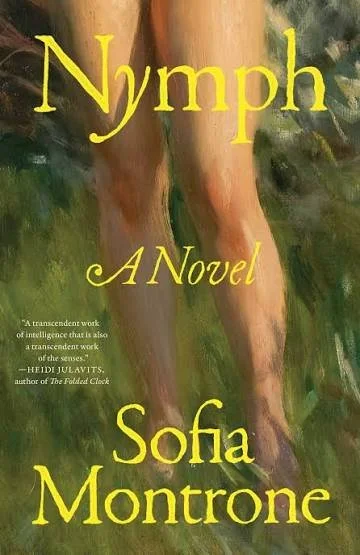
Both novels subvert the expectation of women and nature existing as items of control. In a patriarchal world, nature is feminized. Land is described as fertile. Mother Nature exists in some form universally. But there’s a sense of reclamation in the way Nymph and Girl’s Girl use nature as an engine for a love story that also exists fully removed from maleness. Leo is called a “nymph” and she becomes exactly what the name insists of her. She is a person in the process of transformation, but Montrone still pulls away some from the perfect idea of nature. Instead, it is shown as unstable and messy—carcasses rot, fruits spoil, bodies sweat and bleed—but most importantly indomitable. The same can be said about the novel’s central relationship; no matter how much Leo wishes otherwise, Dolores cannot be held there forever.
In Girl’s Girl, that same indomitability takes on a different form. This early-stage intimacy gives the story this feel like it exists in its own world for these girls. There’s a pureness in the privacy of their shared relationship, their openness with one another. Even their conflicts unfold within this intimate space. The backdrop of nature exists to emphasize the girls’ endless search for the “natural” in a more social capacity, an effortlessness that reads as the girls’ desire to reach some innate form. Mina’s relationship with Eleanor develops there, shaped by perception and performance. Without the usual sense of pursuit or possession seen in more familiar narratives of desire, the relationship exists without hierarchy. Instead, Feldman’s writing subverts the patriarchal norm, and the novel almost floats in an in-between space, contained in the simplicity and fragility of youth and girlhood.
“What we loved was to feel attractive in each other's company, to spur each other on to greater beauty and to experience this ascension as a series of steps we could teach each other to perform—first bronzer, then contour, then a smudged and smoky eyeliner.”
The body is central to each novel as well, though, again their approach is different. Where both the female body and the natural world are often devalued and subsequently controlled, Nymph pushes back through the lyrical prose used even when describing the body and nature at its messiest. Montrone draws beauty into Leo’s exploration of the body, even through blood, snot, sweat, dead skin. Leo is fascinated by these aspects of her body and others’—a child who makes “anthropology projects of tampons and beard trimmings.” There is no refining of the nature or the body, only the admiration of the beauty that exists there regardless.
“When she hauls out the trash, she uses the butt of the wooden tub-brush to sift through the crumpled tissues and tampons. These cylinders of cotton and brown blood are of special interest to her. She admires the attempts to conceal them with folds of toilet paper, the persistence of their seeping, stinking load. She has not yet gotten her period and thinks that when her time comes, she will do a much better job hiding the evidence. The body is a long series of betrayals. Leo must be quicker. She minds her body like a clock.”

Between Mina and friends, Girl’s Girl offers a view in which the girls feel a societal pressure to perform effortless femininity. Feldman situates the novel distinctly in the patriarchal world, one where the friend group is preoccupied with the body and beauty. But it follows Mina through moments where they all resist the societal expectations. Interestingly, the girls are drawn to discussing sex with boys, but the topic rarely stems from desire. Instead they seem to perform the role, a way of learning the structures they are expected to move within. It is a language of connection for them. The true intimacy of the novel falls outside these moments, where Mina and Eleanor’s connection goes against the norm the novel sets up. By the end, Girl’s Girl shows Mina accepting what has taken shape between her and Eleanor—and thus accepting the subversion of the patriarchy. The dynamic has fully shifted from where the novel opens.
Within an ecofeminist framework, these novels begin to suggest that the problem lies both in how women and nature are controlled as well as how deeply that control has shaped what is considered natural in the first place. Nymph and Girl’s Girl resist stability in the body, in nature, and in relationships, pointing toward a way of understanding desire as experience rather than ownership. Montrone and Feldman capture the beauty of femininity and queerness, but never romanticize the intimacy there.
In this way, both novels echo a central idea in ecofeminist thought: the female body and the natural world are never as separate or controllable as they are often made to appear. The fact that both arrive as summer novels feels fitting, their stories rooted in a season defined by transformation but also by its inevitable end.
Montrone and Feldman have created two lovely, atmospheric novels, perfect for a hot day or a nostalgic summer evening.
“We are either going to have a future where women lead the way to make peace with the Earth, or we are not going to have a human future at all.”
—Vandana Shiva
Nymph by Sofia Montrone (Avid Reader Press) - ★★★★★
Girl’s Girl by Sonia Feldman (The Dial Press) - ★★★★☆
About the Reviewer:
Rachel Shaver graduated from Eckerd College with a BA in creative writing and a minor in literature. She lives in Tampa, Florida with her twin sister and spends her days consuming media in all forms. She has been published in Collision Literary Magazine and worked as editor-in-chief for Eckerd Review, as well as editorial intern for Cleaver Magazine.
