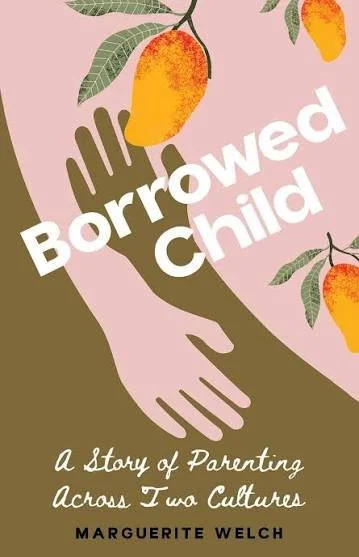
Borrowed Child by Maguerite Welch
Reviewed by Rachel Shaver
“‘What do you know about her life, really? Who she is deep down. What makes her happy, sad, afraid, safe. You have no idea other than what you observe through the prism of your own perspective…’”
Inspired by a real-life mentorship, Borrowed Child is a novel of two parallel narratives. Helen, a mother grieving the loss of her teenage son, takes on tutoring underserved children through a nonprofit, where she meets Mia, a Mexican immigrant navigating a new country and a broken family. Over the years, their relationship has deepened, and Helen has come to see Mia as the daughter she never had, but also as a teenage child she can save after feeling she failed to save her son.
The novel opens, though, with what seems to be the ending. Mia has disappeared from Helen’s life, an unexpected departure that forces Helen to confront the fact she might not have known Mia as well as she thought, or as well as she desperately hoped she did. From there, the story works back, alternating perspectives until the inevitable collapse. Neither character ends up seeming more right than one the other. Both act in love, but do so from different realities, and Welch’s portrayal of these narratives is what allows the story to navigate the nuance of what happens between Mia and Helen.
“We are like the sky and the cloud. They will always and forever be together within storms and tornados. Even when night falls, they will still be together.”
The alternating perspectives are not a stylistic choice made for the convenience of revealing the story’s truth. I found it to be a rare instance where a novel simply could not function the same without the dual narratives. This is because it reveals the fundamentally different understandings that both Mia and Helen have, both of each other and the world around them. Helen has come to replace her lost motherhood with tutoring, and she pours herself into the future of these children. She values education, stability, opportunity and seeks to show Mia this value—how it can provide Mia with the life Helen believes she deserves. But Mia comes from an uprooted childhood, transplanted into an unfamiliar country and culture, while still bogged down by memory, loss, and familial obligation.
Though framed as a story of parenting, there is definitely more beneath the surface. Welch approaches a delicate topic: the difference between culture and the disconnect that can never fully be bridged. All of Helen’s choices are made in good faith, and the book’s entire narrative relies on this well-meaning ignorance. She is extremely generous to Mia, but through it all, her actions are overshadowed by their divide—her assumptions and views all shaped by a middle-class American upbringing. But Mia complicates Helen’s assumptions. Though, never does Welch seem to accuse Helen of true cultural ignorance. Instead, the novel focuses on the unfortunate truth that Helen’s understanding can only ever be partial.
“Why couldn’t I see the tentacles, slowly tangling themselves around your young mind: the moods, the flare-ups, the anger, the insecurity and self-doubt?”
There is also a sense of universality to the novel’s stance. While culture factors in greatly, beyond that, the same can be said about the unknowability of any individual based on various factors. Age, gender, upbringing—anything can create this same divide. The novel says love alone is not always enough, that we can try to empathize, but sometimes the divide can never be fully crossed. Still, it isn’t saying anything dark or fatalistic. It acts more as a meditation on the limits of knowing someone and the work it takes to carry on loving someone anyway.
“I’ve lost track. But I will never forget you.”
Borrowed Child is out on July 14th. Thank you to Mindbuck Media for the advanced copy!
Rating: ★★★★☆
Tactfully rendered story of culture, parenthood, and most of all, humility. Welch addresses the messiness of love but never forgets the beauty of it.
About the Author:
Marguerite Welch is a writer, photographer, and sailor whose eclectic tastes and interests have often led her in unexpected directions. Her articles on photography and travel have appeared online and in various art and literary publications. Her travel memoir, Waterborne: A Slow Trip Around a Small Planet, documents her fourteen-year circumnavigation of the world with her husband, Mike, on a sailboat. Borrowed Child is based on over a decade of experience as a tutor and mentor of children from the underserved communities in her own backyard.
About the Reviewer:
Rachel Shaver graduated from Eckerd College with a BA in creative writing and a minor in literature. She lives in Tampa, Florida with her twin sister and spends her days consuming media in all forms. She has been published in Collision Literary Magazine and worked as editor-in-chief for Eckerd Review, as well as editorial intern for Cleaver Magazine.
