Nerve Damage by Annakeara Stinson
Reviewed by Rachel Shaver
“I didn't want him to lose control. I wanted someone to help him, some witch to place her hands on his head and release every dark thought or compulsion he had, to liberate them with abrupt force, like a flock of birds all leaving the same tree at once.”
From the blurb of Nerve Damage by Annakeara Stinson, I expected a psychologically-charged story of a stalking victim who, in turn, becomes a stalker. Technically, this could be considered true, but for the majority of the novel, we follow Clarice, now living across the country in an attempt to escape her boyfriend, P.T., as she spirals down an all-consuming rabbit hole of believing she has seen him at a local bar, exactly at the expiration of their no-contact order. To say Clarice becomes a stalker feels like a bit of a stretch for this novel, especially since, until the final third of the book, the most Clarice does is ask around about him and think heavily on their past.
“In the place of wanting there's something like static, or a sense of being scraped out with the serrated precision of a grapefruit spoon. It's not clear what is left of me.”
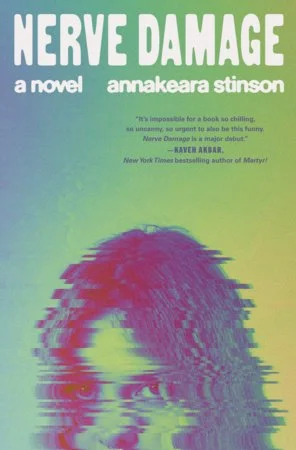
A majority of this journey is one told through Clarice’s psyche, through texts, through what her friends think, through how the past bleeds into her current life. For a novel so drenched in a character’s mental journey, I found Nerve Damage to be lacking in craft elements that would have made the book’s desire to be eerie and psychological much more effective. Clarice’s narration lacks free indirect discourse, distancing us from the most interesting aspects of her mind. Someone says something too close to home and she thinks um, rude. Clarice, in the peak of her most stalker-y behavior, thinks no, no, no, we’re not doing this. Even in the portrayal of her close relationships, the novel relies heavily on text conversations to fill in the blanks of what a reader might not grasp beyond the surface. Her friends have all the answers in this case, adding no complexity to her situation. They have a near perfect understanding of her situation, what she needs to do to fix it, but also boundless empathy when Clarice does not do what they suggest. Clarice’s texted responses, in turn, neatly establish her thoughts and feelings, removing interiority, or even some moral ambiguity one might expect in a psychologically-charged novel.
Beyond this, Nerve Damage is a novel that will make you ask “are there any good relationships out there?” after Clarice runs into, again and again, people in various stages of abusive relationships. This tries to be prophetic, it seems—an external timeline of her upcoming life if she doesn’t get out of this situation, but after the first few, it starts wearing down the symbolism. Clarice encounters what feels like caricatured versions of these relationships—the woman at the court house who keeps getting protection orders and then going back, the neighbors who fight all day and night, the married couple with no love left.
“So much of love is whatever horrible shit only the two of you know. You mistake that for loyalty, living through what you don't want. Enduring is the work.”
It’s convenient at best that she finds so much in the world to help break her from this relationship, but at its worst, it blunts the emotional resonance of this novel. It removes the internal fight that this story prepares you for. It is not a descent into madness much at all, because I think that would require some level of secrecy, some level of immaturity or ignorance that Clarice just can’t believably have when surrounded by constant reminders of what is the right thing to do.
Her friends are too wise, too perfect and consistent in their advice for Clarice to disregard. So when she does, it makes her character a little maddening. Her character arc has plenty of room for flaws, and a story like this requires a certain level of imperfection to pull off, but there’s a constant discordance between her knowledge and her actions that loses the realism this novel needed. I was left wanting a much more personal reckoning for Clarice rather than the story of her being slowly convinced. This novel seems to strive to be a psychological thriller, but Clarice’s choices are often formed outside herself with little interiority for a book with so much room to get strange.
Another aspect of realism I found distracting was P.T.’s depiction as the stereotypical “bad boyfriend.” He is a bad boyfriend, there’s no disputing that, but for someone like Clarice, I felt she needed something to grasp onto, some small positive qualities that make her wish to stay. Much later in the book, Clarice’s troubled childhood is revealed, and for all it tells us, we don’t get much correlation except her skewed perception on good relationships. Yet, there could have been so much more. There is a massive opportunity for depth in P.T.’s character. You expect a man with irresistible charm, a love-bomber, anything to draw Clarice closer through the trauma of her childhood. Instead, it comes off as if she never liked him much, always at the whim of his manic episodes and manipulative behavior. There aren’t moments where we see P.T. and think “that’s why she loved him.”
Strangely, I found myself with an odd sense of sympathy for P.T., whether this was intentional or not on Stinson’s part. His struggles do add a level of complexity to this novel, and I think somehow this is a positive. I wanted this moral grayness, this struggle trusting any character fully, but grasping why they act the way they do. Nerve Damage succeeds in having this threaded throughout. As you read, there is no clear indicator if this man seen in the bar is actually P.T., meaning, in one interpretation, P.T. really just ends on a note of being a man in need of mental health services who—when prompted—did leave Clarice alone. And that means Clarice has taken on this obsession all of her own will. This, I believe is the novel’s heart, and what it strived to say throughout. I wish this conflict could have been more central. By the end, Clarice has gone a little weird, but I wanted so much more—past and present—to really secure this novel’s place as a psychological narrative, a descent into madness.
By the end, I will commend the novel’s slow and steady portrayal of Clarice’s trauma. This was a deftly handled aspect that I think paired well with Clarice’s choices. As we grow to understand Clarice better, her choices grow more complex, more layered, and more driven by this trauma. And beyond that, the novel’s writing is strong, easy to sink into, and steeped in a rich voice that did make this an enjoyable read.
“It's only recently I've begun to suspect that love and struggle are not necessarily one enterprise.”
It is clear to me that Stinson understands the complexity of trauma, but not as much the logic (or lack thereof) of obsession. For a story promising a stalker-turned-stalkee, it remains restrained, never fully inhabiting Clarice’s psyche, leaving me with an awareness of how much more psychologically daring this novel could have been.
Rating: ★★☆☆☆
An easy read with carefully captured trauma. Psychological, but does not succeed at being the “weird girl lit” it could have been.
About the Author:
Annakeara Stinson is a writer whose work has appeared in Bustle, Brooklyn Magazine, The Inquisitive Eater, IndieWire, Paste, Marie Claire, and more. She has an M.F.A. in fiction from The New School and currently lives in L.A.
About the Reviewer:
Rachel Shaver graduated from Eckerd College with a BA in creative writing and a minor in literature. She lives in Tampa, Florida with her twin sister and spends her days consuming media in all forms. She has been published in Collision Literary Magazine and worked as editor-in-chief for Eckerd Review, as well as editorial intern for Cleaver Magazine
