Review by Rachel Shaver
“There were scars all around, they just didn’t look the same.”
Often, a novel achieves complexity by stacking conflicts as the story progresses, until a point where it all collides. Fault Lines by Shirley Hay opens at a point that seems it cannot grow more chaotic. A dying stepmother, a father slipping into dementia, a daughter whose behavior is becoming increasingly troubling, and a family hardly managing to handle it all. Yet, from there, the intricacy grows stronger still, moving in time but also in depth as a past riddled with unspoken grief comes closer to the surface.
“Waiting for impending death is like being buckled into a one-way flight after takeoff, the trip itself is incidental.”
Nadia Browning is a wife, mother of two, and an illustrator who has spent much of her adult life trying to build the stability her own childhood lacked. She was once a daughter, too, one of a mother who struggled with mental illness before dying tragically long ago. In her mother’s place, Nadia grew up with her father and stepmother, Bonnie, whose affection only pushed Nadia away. To Nadia, Bonnie—in all her happiness and enthusiasm—was only a bandage on a wound Nadia was not ready to move past.
Decades later, she has a loving husband and two adult children—by all accounts, her goal of stability seems met, until Bonnie is dying, and Nadia finds herself pulled back into a family dynamic she has spent so much time avoiding. With her father’s dementia worsening and Bonnie coming closer to passing, she takes on the obligations of their care and must face the gradual loss of them both. Set in the familiar spaces of her childhood and the increasingly unfamiliar presence of her father, Nadia finds the past growing difficult to ignore.
“She ached to take away his pain, this pain that didn’t just belong to one sick person, but spread to all of them like spilled oil, sticky and glutinous. Not easily washed away.”
Meanwhile, Nadia’s adult daughter Lauren is growing erratic, her troubling behavior raising the fear that, despite her best efforts, Nadia might have failed to break the generational cycle of trauma plaguing her. As old memories resurface and new crises unfold, she begins to discover how unresolved her grief has always been, how the painful patterns of her childhood still weigh on her today. But it is Bonnie, the woman Nadia has spent decades keeping at a distance, who ultimately breaks open everything she thought she knew about her family and, even more so, herself.
Fault Lines is an intricately layered narrative, and one that a synopsis does only so much justice to describe. Throughout the novel, Hay sets two aspects of memory beside one another—Nadia’s desire to forget and her father’s involuntary forgetting. And from the two coming together, the novel is structured to present both remembering and forgetting as different forms of loss. Though as the novel progresses, memory comes to be more than just a burden for Nadia, as it’s also what allows her to ultimately move forward.
“These were the choices of broken people. The choices made when pain is unbearable. This was survival.”
Fault Lines moves chronologically through present day, with interjections of memory. These feel less like a conventional, reflective flashback and more like an intrusion of remembering, and so the past and the present unfold with an equal immediacy. The timelines rarely blur. Instead, the interruptions remain distinct, and the writing feels richly interior as it explores Nadia’s (unsuccessful) attempts at avoidance.
Beyond the complexities of memory, Hay manages a plot that steadily reveals truths of the past as Nadia fights against it. The prose is rich and lyrical at times, pausing at moments of unexpected beauty amid this family’s grief. Hay’s attention to detail is especially effective in her characterization of Bonnie, whose bright makeup and exaggerated cheer function first at surface level to confirm Nadia’s superficial judgments of her. Then, through Hay’s strategic prose, those same details take on a meaning much more complicated, one that begins to gather emotional weight as it goes along. By the time you reach the final pages, Hay hits hard with every word, and I found myself moved more with each passing moment of the ending.
“Not everyone loves the masquerade, some are forced to attend, with heavy armour and weapons in their pockets. Some cower in corners. Some find their costumes so itchy and uncomfortable that they can do nothing but finally shed them, dropping it all on the marble floor until there they stand, naked and unprotected and defenceless to everyone’s eyes. A daddy-long-legs exposed in a library book. A person, stuck in place.”
There is a great deal happening in Fault Lines, but it's the way Hay allows each storyline to illuminate the other that makes this novel into something cohesive through all its family crises. Through a careful structure and rich, moving characters, Fault Lines is able to begin in chaos and end somewhere without perfect conclusion, all without ever losing sight of the story at its center.
Rating: ★★★★★
For fans of Little Fires Everywhere, tangled and deeply emotional narratives of a family, both past and present.
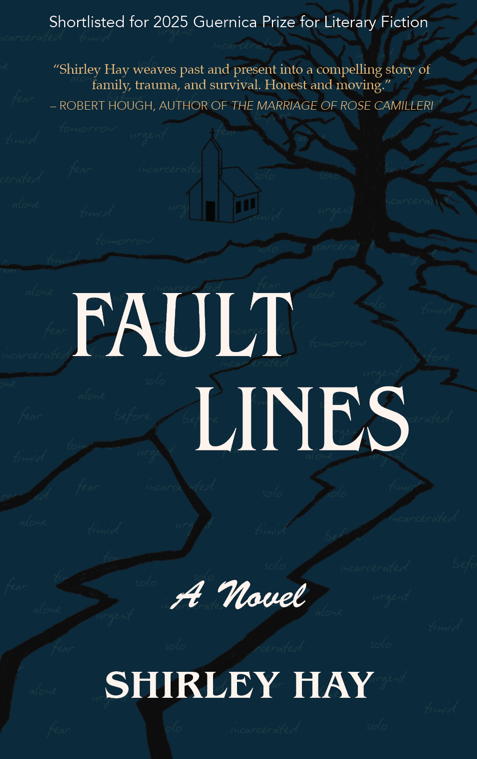
Shirley’s short form fiction and creative non-fiction have appeared in various journals and anthologies, including Off Topic Publishing, Creation Magazine (Feminist & Blueprint Issues), The 50-Word Stories of 2024 & 2026 (Vine Leaves Press), and heard on the podcasts Jacqui Just Chatters and Bookish Flights. Her short story RIGHTING MY WORLD was also released as an ebook after its original publication in the anthology Another Chance to Get it Right (&YouPress). Shirley’s debut novel FAULT LINES was shortlisted for the 2025 Guernica Prize for Literary Fiction and releases on November 1st, 2026. It is currently available for preorder.
Rachel Shaver is a fiction writer and editor from Florida. She graduated from Eckerd College with a BA in creative writing and a minor in literature. Her work has been published in Collision Literary Magazine and J Journal. She is an MFA candidate at Cornell University and spends her days in Ithaca, NY, writing and consuming media in all forms.
